
Knowing how to tell if Pokémon cards are fake matters more than ever. As card prices have risen, so has the number of counterfeits, and fakes now turn up in online listings, market stalls and trade binders. The good news is that most fakes fail a few simple checks. This guide gives you a nine-step checklist, explains what grading companies do with fakes, answers whether gold Pokémon cards are real and shows how to buy safely.
Quick checklist: back colour → font and accents → Energy symbols → holo → feel → compare with a real card from the same set.
Table of Contents
Why fake cards are common
Counterfeiters target the cards people pay the most for: Charizard, Pikachu, modern special illustration rares and gold hyper rares. If a card is valuable, someone has probably tried to fake it. That is why it is worth learning how to spot fake Pokémon cards before you buy anything expensive, especially from a private seller.
The best tool you have is a real card. Keep a genuine common from the same set nearby and compare the two side by side. Most of the checks below are much easier with a real card to compare against, and comparing is the simplest way to learn how to tell if Pokémon cards are fake.
How to tell if Pokémon cards are fake: 9 checks
1. The back colour
Start with the back. Genuine cards use a dark blue that can vary slightly from card to card. A pale or washed-out blue back is a red flag. Compare the back closely with a real card, especially the swirls around the top right of the Poké Ball. One collector guide says this single check catches around 80% of fakes. If you only remember one tip on how to spot fake Pokémon cards, make it this one.
2. Font and text
Look at the words. Fakes often use the wrong font or uneven spacing, and many miss the accent on the “é” in Pokémon. Watch for misspelled Pokémon names, misspelled illustrator names and grammar mistakes in attack text. Real cards rarely have errors like these, so they are a strong warning sign.
3. Energy symbols
Check the Energy symbols in the attack costs. On fakes, they are often the wrong size or design, with the artwork inside the symbol too large.
4. The holo foil
Counterfeit holo foil usually looks weaker and flatter than the real thing. On some fakes, the foil makes the attack text hard to read, and some fakes even have a holo where the real card has none.
5. Feel and card stock
Fakes often use cheaper card stock. They often feel different from a real card, for example thinner, glossier or more flexible, and they tend to wear faster. If a card feels different in your hand from your other cards, look more closely.

6. The black inner layer
Genuine cards have a thin black layer in the middle of the card stock, which you can sometimes see when you look closely at the edge. Most fakes do not have it. The “rip test” tears a card in half to look for that layer, but it destroys the card, so only ever try it on a card you already believe is fake.
7. The light test
Some collectors shine a phone light through a card, because fakes often let more light through. Use it with care, though: Bulbapedia’s counterfeit card guide calls the light test unreliable, as the result depends on the light source and distance. Always compare with a real card.
8. Colours and print quality
Look at the artwork. Fakes often have off colours, blurry or low-resolution art and fuzzy text. Older fakes are sometimes missing the copyright line at the bottom of the card.
9. Edges and set symbol
Small leftover bits of cardboard on the edges can be a sign that a card was punched from a sheet. Also check the set symbol: Base Set is the only expansion printed with no set symbol (apart from some Jungle error cards). A “Base Set” card with a symbol, or a later card without one, needs a closer look.
A note about HP
Some guides say that HP or damage over 300 is a sign of a fake. Be careful with that rule today. Modern Mega Evolution Pokémon ex cards really do have very high HP, for example Mega Mawile ex has 270 HP, so check the real card before you decide.
How to spot fake Pokémon cards in one minute
Here is a quick routine for how to spot fake Pokémon cards when you are looking at a card in person:
- Flip it over and compare the blue back with a real card.
- Read the name and attack text, checking the accent on “Pokémon”.
- Look at the Energy symbols and the holo.
- Bend it very slightly between your fingers to feel the stock, without creasing it.
- Check the edges and the set symbol.
If a card fails two or more of these checks, walk away.
What grading companies do with fakes
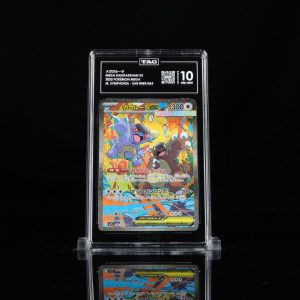
Grading companies check authenticity as well as condition. PSA, for example, returns suspect cards ungraded with the code N4, which means questionable authenticity, as listed in its grading standards. If you are buying an expensive card, a graded copy from a trusted company gives you extra peace of mind. Graded cards are the safest option if you are not sure how to tell if Pokémon cards are fake yourself. Browse our graded cards.
Are gold Pokémon cards real?
Are gold Pokémon cards real? Some are, but most gold cards sold online are not official. Here is what is real:
- Burger King 1999 gold cards: Burger King sold six 23-karat gold-plated metal Pokémon cards as a promotion for Pokémon: The First Movie. Each came in a plastic Poké Ball with a certificate.
- Gold hyper rares: the “gold cards” you pull from modern packs are hyper rares, marked with three gold stars. They are normal card stock, not metal.
- Gold-coloured promos: some premium boxes have had gold-coloured full-art promos, like Zacian V and Zamazenta V in the 2020 Zacian & Zamazenta Ultra-Premium Collection. The metal items in that box were coins, dice and markers, not cards.
Modern premium boxes list metal coins, but not metal cards. So if someone sells you a shiny gold metal Charizard that is not from an official source, treat it as an unofficial novelty item, not a real Pokémon card. So, are gold Pokémon cards real? Only the ones from official sources like these.
How to buy safely
Learning how to tell if Pokémon cards are fake is useful, but avoiding fakes in the first place is even better. The easiest way to do that is to buy sealed product from the official Pokémon Center or an established retailer. Watch out for resealed packs, where the hits have been taken out and the pack glued back together, and for sellers who ship fakes or nothing at all.
- Buy from stores with clear contact details and a returns policy.
- Be careful with prices that look too good to be true.
- For singles, ask for clear photos of the front, back and edges.
- For valuable cards, choose graded copies from a trusted company.
 Mega Evolution: Ascended Heroes Elite Trainer Box
 Mega Evolution: Delta Reign Elite Trainer Box (ME06)
Frequently asked questions
What is the quickest way to spot a fake?
Compare the back with a real card. The blue on most fakes is too pale or the pattern looks wrong.
How to spot fake Pokémon cards without a real card to compare?
Check the font, accents, Energy symbols and holo, then look up a clear photo of the real card online and compare the details.
Can fake cards be graded?
No. Grading companies like PSA return suspect cards ungraded, with a code such as N4.
Are all metal Pokémon cards fake?
Not all, as the 1999 Burger King cards were real, but most metal cards sold online today are unofficial novelties.
Keep learning
Now you know how to tell if Pokémon cards are fake, learn what Pokémon cards are worth money, or read our guide on how to start collecting Pokémon cards. When you are ready to buy, visit our trading card shop, where you can shop sealed products and graded cards.